Micropayments
x402/MPP and service-spend budgets for machine payments
When agents are paying for APIs, inference, or compute by the call, Conto applies per-request caps and session budgets so service spend stays bounded even when the agent is making many decisions per minute.
Industries
Compute & AI infra · Agentic commerce
Best for
Inference, APIs, service spend
Controls
Per-call caps, session budgets, velocity
Outcome
Machine-speed buying with hard limits
Product
Conto products behind service-spend budgets
Runtime controls
Policy Engine
Define the rules for how agents spend, then evaluate every payment request before funds move. Conto keeps limits, categories, trust requirements, and approval rules in the transaction path.
Explore productWallet operations
Agent Wallets
Give each agent a wallet or card surface that can be governed by policy, monitored by finance, and connected to the payment workflows it owns.
Explore productFinancial visibility
Audit and Reconciliation
Attach agent, counterparty, policy, approval, and execution context to every transaction so finance can understand what happened without chasing separate systems.
Explore productWorkflow
How per-call payments stay inside budget
Agents can buy APIs, inference, and compute at machine speed while Conto checks unit economics and task budgets before each paid request.
Step 1
The agent chooses a paid service
A compute or API workflow selects the service endpoint and proposes the call based on price, latency, or task fit.
Step 2
Conto checks call-level economics
Per-call limits, session budgets, provider rules, and velocity constraints are evaluated before the service request settles.
Step 3
Normal usage continues until budget is spent
Low-cost calls keep flowing. Expensive routes or exhausted budgets are blocked before the provider is paid.
Controls
Controls that bound machine-speed service spend
Per-call, session, provider, and velocity policies stop runaway spend without forcing every low-cost request into manual review.
Per-call ceilings
Prevent a single API or inference request from blowing past the allowed unit economics for the task.
Session envelopes
Give each task or agent run a hard budget so many small calls cannot add up to an unlimited bill.
Provider-level policy
Restrict autonomous spend to the providers or service types you actually trust for the workflow.
Velocity monitoring
Catch broken loops or runaway retry behavior before the agent can hammer a paid endpoint continuously.
Visibility
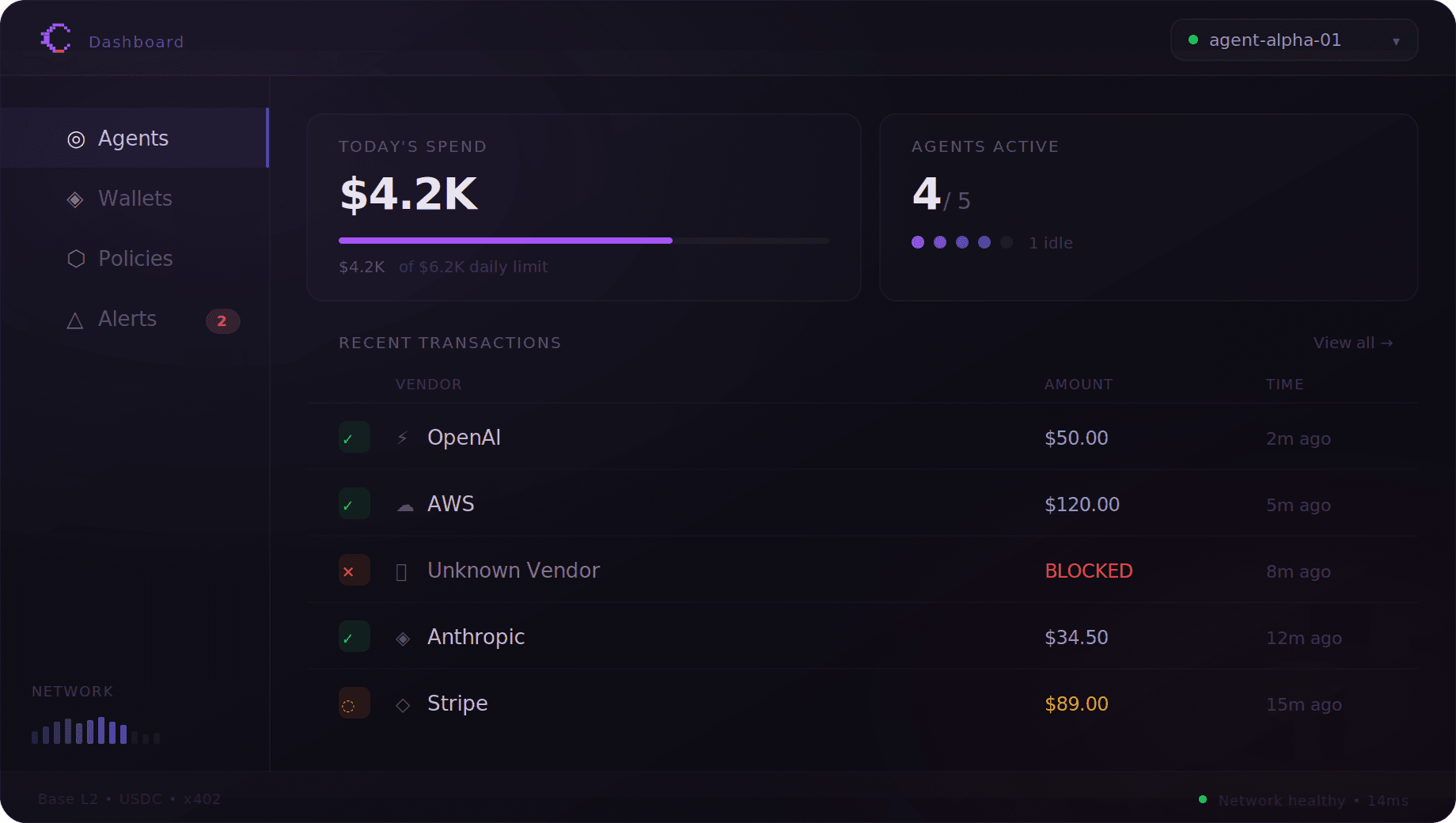
Service-spend activity with budget context attached
Machine-speed payments show up with the same context as enterprise approvals and budgets, which makes service-spend automation easier to govern alongside the rest of the payment estate.
Demo
Compute & AI infra reference workflow
Compute & AI infra applies this solution to a realistic agent payment workflow, with approved payments, review paths, and blocked requests visible from request to settlement.
Outcomes
What teams gain from governed machine payments
Engineering teams can let agents buy services dynamically without accepting unbounded cost exposure.
The same control plane works for per-call infrastructure spend and more traditional payouts.
Every paid request comes with a budget story that finance can understand.
Related