Try Conto with Anthropic Commerce Agent Templates
Anthropic released commerce agent templates for retail, travel, and ticketing. They give developers a working starting point for agents that help people shop and help merchants run their businesses, with the agent loop, tools, and guardrails already in place.
The part we're interested in is the buyer's authority: once an agent has found something worth buying, what gives it permission to spend? Our shopping, travel, and ticketing demos pair Anthropic's agents with Conto's spending controls. You can ask for a recommendation, compare options, and build an order. Conto belongs in the buyer’s payment path, checking the owner’s rules before execution.
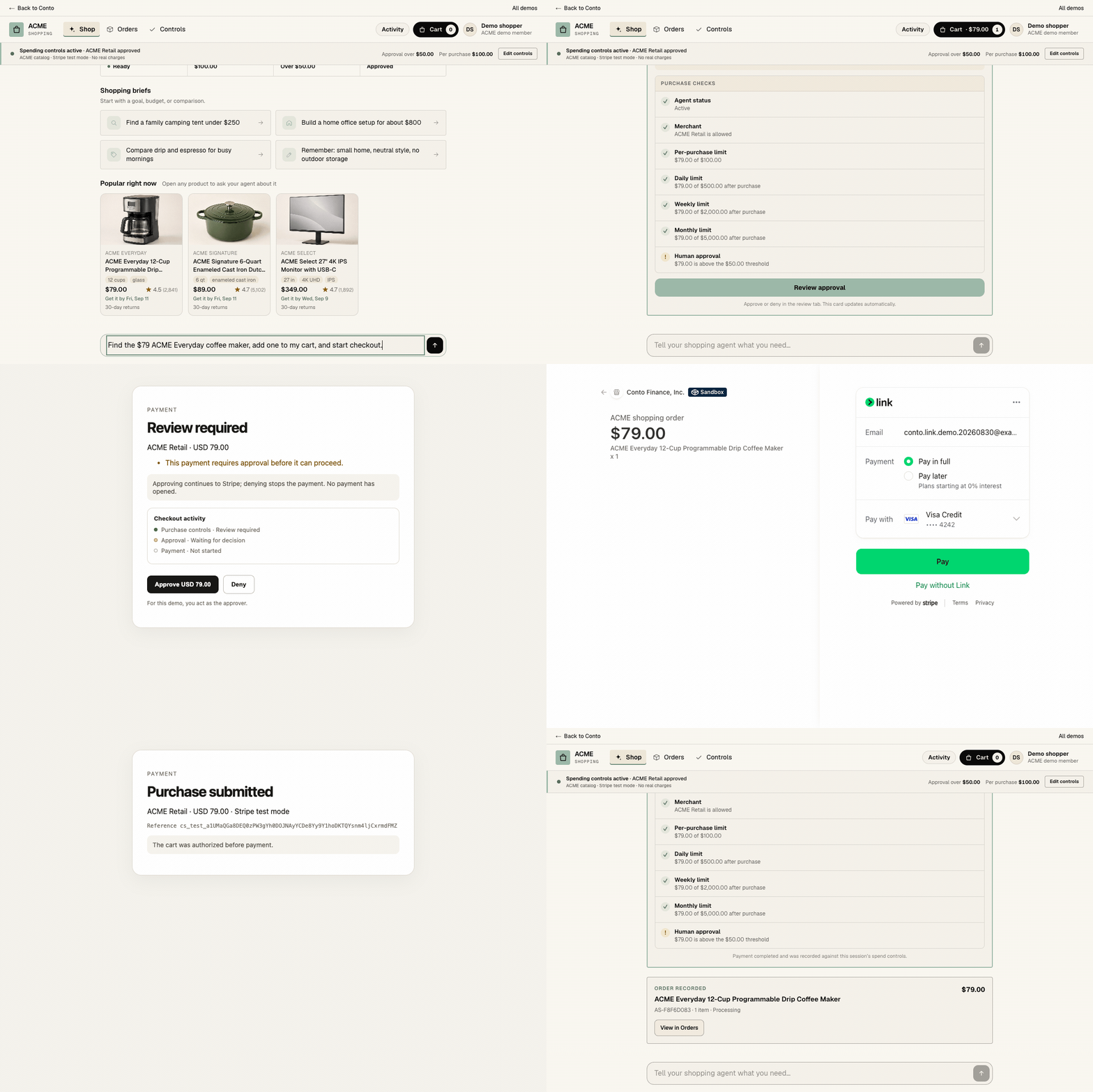
What the templates handle
Anthropic's guide to effective commerce agents explains the design. A shopping conversation stays with one main agent, with skills for different tasks. Product cards, itineraries, and seat maps come from tools whose inputs the server validates. Listings and reviews are treated as untrusted information, with safeguards enforced in code.
This part is deliberate. As Anthropic puts it in the guide:
No model tool call moves money or changes the business.
The shopping agent can assemble a cart, but its backend has no method to charge a card, so checkout happens through a separate flow. Merchant changes, such as a price update, are staged and wait for approval before they take effect. The model proposes the action, and a person or a policy decides whether it goes through. The templates give you the agent and leave that decision to the systems your business already uses to authorize a purchase.
Where Conto comes in
That decision is where Conto sits. The templates hold the agent back from spending on its own. Conto gives it room to spend inside limits you set, so it can pay for what you allow and gets stopped on what you don't. Those rules belong to you rather than to a single chat, so they hold across sessions, across merchants, and across every agent you run. They also weigh who is being paid, not only what is in the cart.
An agent reordering office supplies is a useful example. You might be happy for it to buy printer paper from your usual supplier, provided the cost comes out of the office budget. A $2,000 furniture order deserves a review, even if it's from that same supplier. As the agent owner or budget holder, you set its spending limits, allowed merchants, and approval requirements in Conto. Each payment request is checked against those rules before it can go ahead, with three possible outcomes:
- Allow: The purchase is within policy and can proceed without an additional Conto approval.
- Ask: The purchase needs a person's approval before it can proceed.
- Block: The purchase breaks a rule and cannot proceed.
An allowed request still needs to go through checkout or a payment provider to complete the charge. Conto's approval answers whether the purchase is permitted; it doesn't mean the payment has succeeded. When several agents share a budget, that permission also depends on what the others have already spent. Each could make a reasonable purchase and still overspend in total, which is why the business needs to track spending across requests rather than rely on a budget mentioned in each chat.
The hard part just moved
Building a commerce agent used to be the work. You had to manage the context, design the tools, keep the model from acting on a bad review, and test the whole thing. That effort is what kept most commerce agents stuck at the demo stage.
The templates take care of it, so a team can stand up a capable shopping agent in days. That moves the real question to the other side of the purchase. Once the agent is easy to build, whether you can deploy it comes down to whether you can trust it with money. Will it stay inside a budget? Will it pay a supplier you approved? Will it check with you on the large orders and clear the small ones on its own?
With one agent and one person watching, you can answer that by hand. Across a hundred agents buying for a thousand people, the answer has to live in policy and run on every request. Conto handles that part, and it is what turns a working demo into something a business can hand to its agents.
Try it in the demos
We built three examples on Anthropic’s templates, pairing merchant catalog fixtures with buyer controls you can change as you shop:
- Shopping: Find products, compare options, and build a cart. Try asking for a camping tent or a home office setup, then check the purchase against your spending limit.
- Travel: Plan flights, stays, and experiences. Put together a trip and see how its total fits your budget and approval rules.
- Ticketing: Find an event and hold seats. Review the total, including fees, before the purchase goes through Conto's checks.
Open Controls and set a purchase limit, then build a cart and try checkout. Lower the limit below the cart total and try again to see how the decision changes. You can also change the allowed merchants and the amount above which a purchase needs your approval.
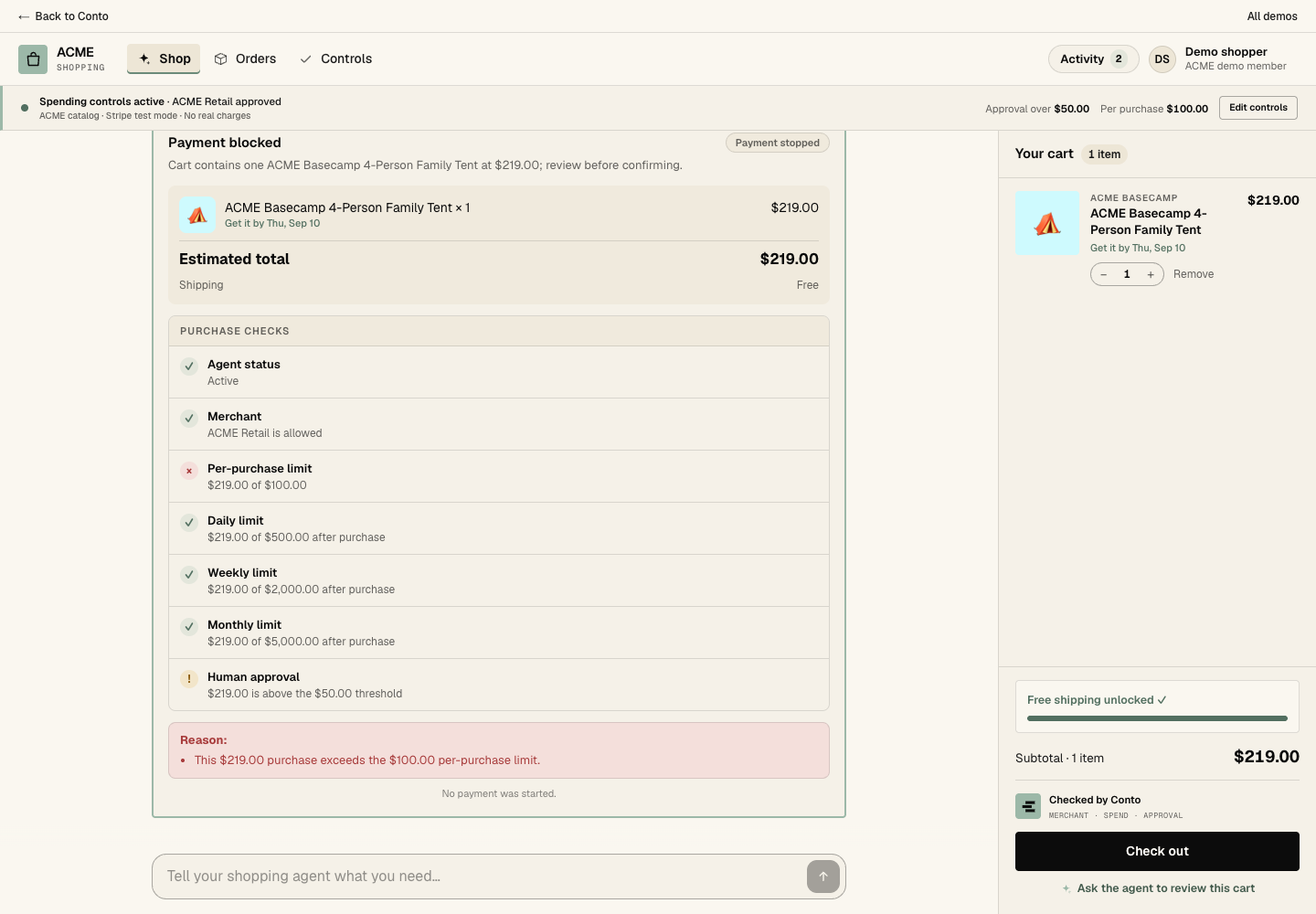
Conto stops the $219 purchase at checkout because the per-purchase limit is $100. The decision shows which check failed, and no payment is started.
The ACME catalog is fictional. These examples currently demonstrate buyer policy decisions without executing a payment. Its earlier merchant-key Stripe checkout did not demonstrate buyer-side control and is disabled in the reference code. Buyer-account card execution requires a connected provider and buyer executor; these examples do not establish support for arbitrary merchant websites.
Let agents finish the job
We wrote recently about agents that take action. An agent that can complete a purchase can act on the result: confirm the booking, adjust after a decline, or move on to the next part of the task. For the person responsible for the budget, the question is whether they can leave the agent to do that work. They need to know it will ask about the furniture order without asking about every box of paper. That's what we're testing with these demos: letting the agent handle the shopping while the buyer sets the terms under which a purchase can go ahead.
Building a commerce agent? Get in touch to see how to connect Conto to your buyer runtime for owner-defined limits and purchase approvals.